Rubber Pavement
Rubber Pavement Over Existing Concrete: When Resurfacing Makes Sense
Old concrete does not always need to be torn out to look new again. When the existing substrate is suitable, resurfacing can change an outdoor space without demolition.
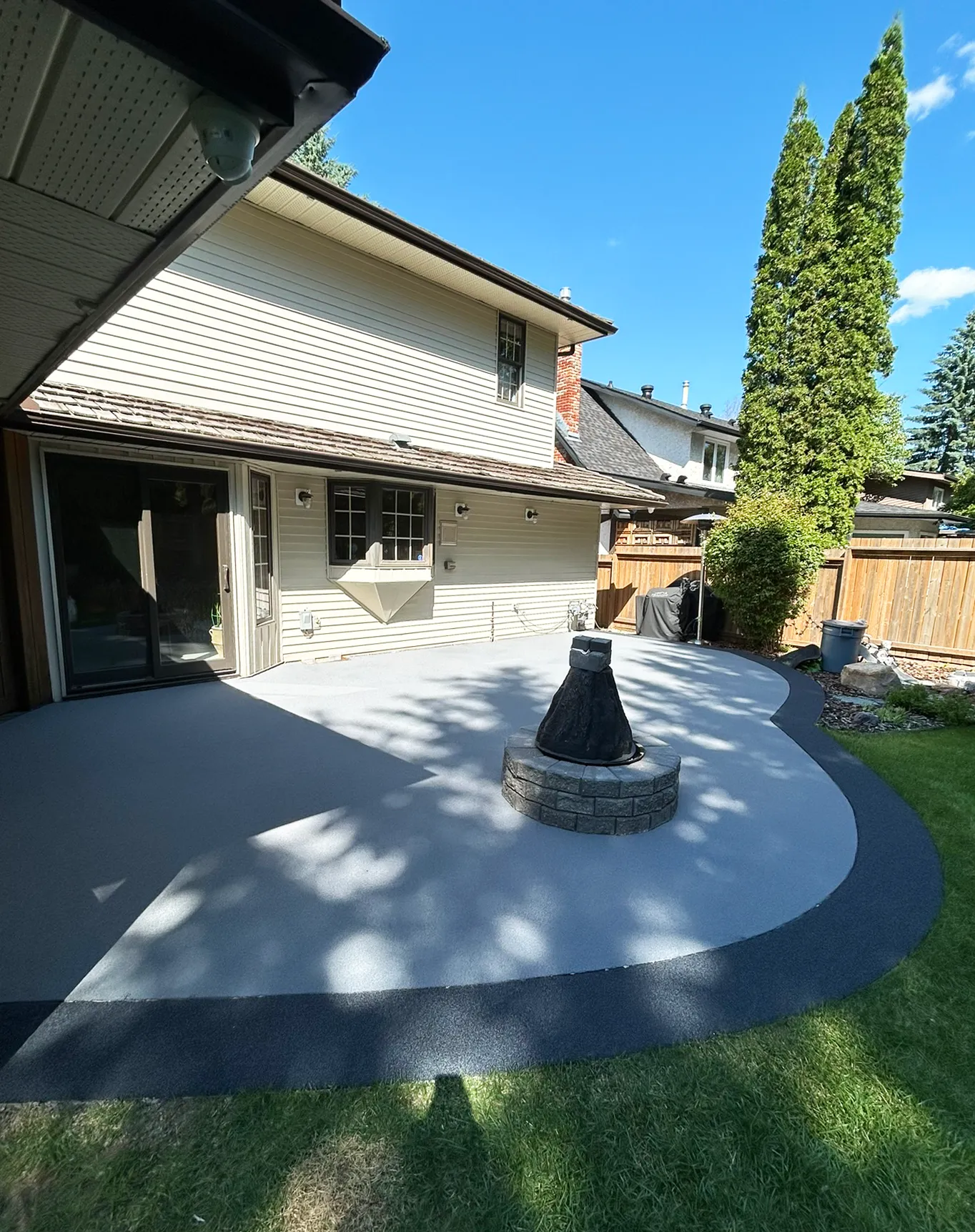
Old concrete does not always need to be torn out to look new again.
For Alberta homeowners and property owners dealing with an aging patio, walkway or recreational surface, complete concrete replacement may seem like the obvious next step. But when the existing surface is still suitable for resurfacing, Rubber Pavement can provide another option.
Rather than demolishing the existing concrete and starting over, Rubber Pavement can be installed over appropriate surfaces to create a new, resilient exterior finish.
The key word is appropriate.
Resurfacing is not about hiding serious problems underneath a new material. The condition of the existing surface needs to be assessed first to determine whether it can provide a suitable foundation for the Rubber Pavement system.
When it can, resurfacing may completely change the appearance and usability of an outdoor space without automatically resorting to concrete removal and replacement.
What Is Rubber Pavement?
Rubber Pavement is an exterior surfacing system made for outdoor applications.
DJ Durepoxy Coatings uses Rubber Pavement for suitable patios, walkways, playgrounds, recreational spaces, tennis courts and other exterior surfaces throughout Alberta.
Unlike epoxy flooring systems, which DJ Durepoxy uses for appropriate indoor applications, Rubber Pavement is intended for outdoor environments.
That distinction is especially important in Alberta, where exterior surfaces are directly exposed to snow, ice, rain, sunlight and substantial seasonal temperature changes.
DJ Durepoxy does not install epoxy outdoors.
When an exterior surface needs to be improved, Rubber Pavement is the outdoor surfacing solution.
Can Rubber Pavement Be Installed Over Existing Concrete?
In suitable circumstances, yes.
One of the major advantages of resurfacing is the ability to work with an existing substrate rather than automatically removing it.
That can make Rubber Pavement particularly interesting for homeowners who have concrete that has become worn, dated or unattractive but may still provide an appropriate foundation for resurfacing.
The existing concrete still matters.
Before Rubber Pavement is installed, the surface needs to be evaluated to determine whether its condition is suitable for the system.
Resurfacing should never be confused with pretending the underlying surface does not exist.
The finished system depends on what is underneath it, which is why professional assessment and preparation remain important.
When Is Resurfacing Worth Considering?
Many exterior concrete surfaces show their age long before the entire structure necessarily needs to be removed.
Years of weather exposure can leave concrete looking faded, stained, worn or generally tired.
A patio that once looked clean and new may gradually become one of the least attractive parts of a backyard.
A walkway may still perform its basic function while looking dated compared with landscaping, siding or other improvements made around it.
Recreational areas may also benefit from a more finished surface even when the existing base remains useful.
These are the kinds of situations where resurfacing is worth exploring.
Instead of beginning with the assumption that old concrete must be demolished, property owners can first determine whether the existing surface is a candidate for Rubber Pavement.
When Is Resurfacing Not Enough?
Rubber Pavement is a resurfacing solution. It is not a substitute for correcting serious underlying structural problems.
If an existing surface has significant movement, instability or other conditions that make it unsuitable as a substrate, simply covering it is not the answer.
This is why evaluating the existing area before installation matters.
There is an important difference between improving an aging surface and attempting to conceal a problem.
A professional contractor should be able to look at the proposed project, consider the condition of the existing substrate and determine whether resurfacing is an appropriate approach.
The best project is not the one that uses Rubber Pavement at any cost.
It is the one where Rubber Pavement is the right solution for the surface.
Why Resurface Instead of Replace?
Concrete replacement is a substantial project.
Existing material may need to be broken apart, removed and hauled away before the new surface can even begin to take shape.
Then new concrete needs to be placed and finished.
There are certainly situations where replacement is necessary.
But when an existing surface is suitable for resurfacing, removing it simply because it looks old may mean undertaking more work than the project actually requires.
Rubber Pavement provides another possibility.
Rather than thinking only in terms of keeping the old concrete or replacing it, homeowners can consider whether the existing surface can become the foundation for something new.
That can fundamentally change the way an exterior renovation is approached.
Resurfacing Can Transform More Than the Surface
A patio takes up a large amount of visual space in a backyard.
So does a walkway leading toward a home.
When those surfaces are worn, stained or visually dated, they can affect the way the entire property feels.
Homeowners sometimes respond by improving everything around the concrete.
They update landscaping, purchase new outdoor furniture, replace fencing or improve exterior lighting, only to discover that the old concrete has become even more noticeable beside all the new improvements.
Changing the surface itself can help bring the space together.
Rubber Pavement can turn the ground beneath an outdoor living area into part of the renovation rather than something the renovation has to work around.
What About Cracked Concrete?
Cracking is one of the first things homeowners notice when looking at older concrete.
It is also one of the reasons a professional assessment is important.
Concrete can crack for many different reasons, and not every crack represents the same condition.
A surface with minor age-related imperfections is very different from one experiencing substantial movement or instability.
The objective should not simply be to make cracks disappear from view.
The objective is to determine whether the existing substrate is suitable for resurfacing.
That distinction protects the quality of the finished project.
Rubber Pavement can provide a new surface, but the condition of what lies underneath still matters.
Alberta Weather Makes Exterior Surface Selection Important
An outdoor surface in Alberta has a difficult job.
During summer, it may experience intense sun and heat.
Within the same year, that surface can be covered by snow and exposed to temperatures well below freezing.
Spring and fall add periods where temperatures may repeatedly move above and below the freezing point.
Moisture arrives as rain, melting snow and ice.
Unlike an interior garage or basement floor, an outdoor surface never gets a season off from the environment.
That is why DJ Durepoxy separates its indoor and outdoor surfacing solutions.
Professional epoxy and coating systems are used for suitable interior spaces.
Rubber Pavement is used outside.
Putting the right material in the right environment is part of creating a better project from the beginning.
Rubber Pavement for Patios
Patios are one of the most obvious opportunities for exterior resurfacing.
A patio is increasingly treated as an extension of the home's living space.
Outdoor kitchens, dining areas, fire tables, seating areas and landscaping can turn a backyard into a place where families spend a significant amount of time.
Old concrete can work against that transformation.
Even when the furniture and landscaping are new, the original patio surface may still make the area feel unfinished.
For a suitable existing patio, Rubber Pavement can provide an entirely different visual foundation for the space.
Instead of designing around old concrete, the surface itself becomes part of the upgrade.
Rubber Pavement for Walkways
Walkways are highly functional, but they also influence a property's first impression.
They guide people through the space and visually connect different areas of the property.
An aging walkway can therefore have a greater effect on appearance than its size might suggest.
Where the existing substrate is appropriate, resurfacing with Rubber Pavement can refresh the walkway without treating the project as though the entire existing surface automatically needs to be replaced.
That can make it an attractive consideration for homeowners undertaking broader exterior improvements.
Rubber Pavement for Playgrounds and Recreational Areas
Rubber Pavement is not limited to residential patios and walkways.
DJ Durepoxy also installs the system for suitable playgrounds, tennis courts and recreational applications.
These environments demonstrate the versatility of rubberized exterior surfacing.
A recreational surface has to function as part of the activity taking place on it while remaining exposed to Alberta weather.
The installation therefore needs to be considered in relation to both the existing substrate and the intended use of the finished space.
Schools, organizations, municipalities, property managers and other owners of recreational spaces may all encounter situations where resurfacing is worth evaluating before automatically planning complete surface replacement.
Rubber Pavement and Outdoor Renovation Planning
One of the best times to consider resurfacing is before the rest of an exterior renovation is finalized.
The surface underneath a patio, walkway or recreation area affects many other design decisions.
If homeowners know they want to update an aging outdoor surface, including it in the renovation plan from the beginning can create a more cohesive finished space.
Instead of selecting furniture, landscaping and other finishes around old concrete, the entire area can be considered together.
Rubber Pavement can then become part of the design rather than an afterthought.
How Long Can Rubber Pavement Last?
DJ Durepoxy advises that a professionally installed 3/4-inch Rubber Pavement surface can have an expected lifespan of approximately 20 to 25 years under appropriate conditions.
Actual service life depends on the existing substrate, installation conditions, use, maintenance and the environment the surface experiences.
Longevity should therefore be considered in context rather than treated as a guarantee that every surface will perform identically.
What matters is beginning with an appropriate application, correctly assessing the substrate and professionally installing the system.
DJ Durepoxy provides a 5-year warranty on Rubber Pavement installations.
Is Rubber Pavement Maintenance Difficult?
Outdoor surfaces inevitably collect dirt and debris.
That is part of living in Alberta.
Leaves, dust, soil, rain, snow and everyday outdoor activity all eventually find their way onto patios and walkways.
Like any exterior improvement, Rubber Pavement benefits from routine care and keeping the surface reasonably clean.
Maintenance should be considered part of protecting any investment made outdoors, whether that investment is landscaping, a deck, a patio or a resurfaced recreational area.
The advantage of improving the surface is that property owners are maintaining something they actually enjoy looking at rather than simply tolerating aging concrete.
Rubber Pavement vs. Epoxy Flooring
The two systems should not be viewed as competing versions of the same product.
They solve different problems.
Inside garages, basements, shops and commercial spaces, DJ Durepoxy provides professional coating systems including epoxy, decorative flake, metallic epoxy and polyaspartic applications.
Those projects begin with appropriate concrete preparation and surface grinding.
Outside, DJ Durepoxy installs Rubber Pavement.
Keeping those applications separate makes the choice much simpler.
If the project is an appropriate indoor concrete floor, a professional coating system may be the solution.
If the project involves a suitable outdoor surface, Rubber Pavement should be considered.
Rubber Pavement Installation Throughout Alberta
DJ Durepoxy Coatings provides Rubber Pavement installation for residential, commercial and recreational projects throughout Alberta.
That includes projects in Edmonton, Sherwood Park, St. Albert, Leduc, Beaumont, Fort Saskatchewan, Vegreville, Red Deer and communities across the province.
The first step is determining whether the existing surface is suitable for resurfacing and what preparation the project requires.
From there, DJ Durepoxy can recommend an approach based on the actual surface and intended use rather than assuming every exterior project is the same.
All DJ Durepoxy work is backed by a 5-year warranty.
Before You Tear Out Old Concrete, Look at Your Options
An aging concrete surface does not automatically need to become a demolition project.
If the existing substrate is suitable, Rubber Pavement may provide an opportunity to transform it instead.
For homeowners, that can mean giving an old patio or walkway an entirely new appearance.
For commercial and recreational properties, it can mean rethinking an existing outdoor surface rather than immediately assuming complete replacement is necessary.
The important first step is understanding what you already have.
DJ Durepoxy Coatings can assess your existing surface and determine whether Rubber Pavement is an appropriate solution for the project.
Frequently Asked Questions
Can Rubber Pavement be installed over old concrete?
Yes, Rubber Pavement can be installed over suitable existing concrete. The condition of the substrate should first be assessed to determine whether it is appropriate for resurfacing.
Do I have to remove my concrete before installing Rubber Pavement?
Not necessarily. One of the advantages of resurfacing is that suitable existing surfaces may be retained rather than automatically demolished. Whether that is possible depends on the condition of the existing substrate.
Can Rubber Pavement cover cracked concrete?
The condition and nature of cracking need to be assessed before installation. Rubber Pavement should not be used simply to conceal an unsuitable or unstable underlying surface.
How long does Rubber Pavement last?
DJ Durepoxy advises that a professionally installed 3/4-inch Rubber Pavement surface can have an expected lifespan of approximately 20 to 25 years under appropriate conditions. Actual performance depends on the substrate, use, installation, environment and maintenance.
Can Rubber Pavement be used for patios?
Yes. Suitable patios are one of the outdoor applications where Rubber Pavement can provide a refreshed exterior surface.
Can Rubber Pavement be used for playgrounds or tennis courts?
Yes. DJ Durepoxy installs Rubber Pavement for suitable playgrounds, tennis courts and other recreational applications.
Does DJ Durepoxy install Rubber Pavement throughout Alberta?
Yes. DJ Durepoxy provides Rubber Pavement installation for suitable projects throughout Alberta.
What warranty does DJ Durepoxy provide on Rubber Pavement?
DJ Durepoxy provides a 5-year warranty on all work, including Rubber Pavement installations.